
Can I Be Employed and Run My Own Business at the Same Time in Norway?
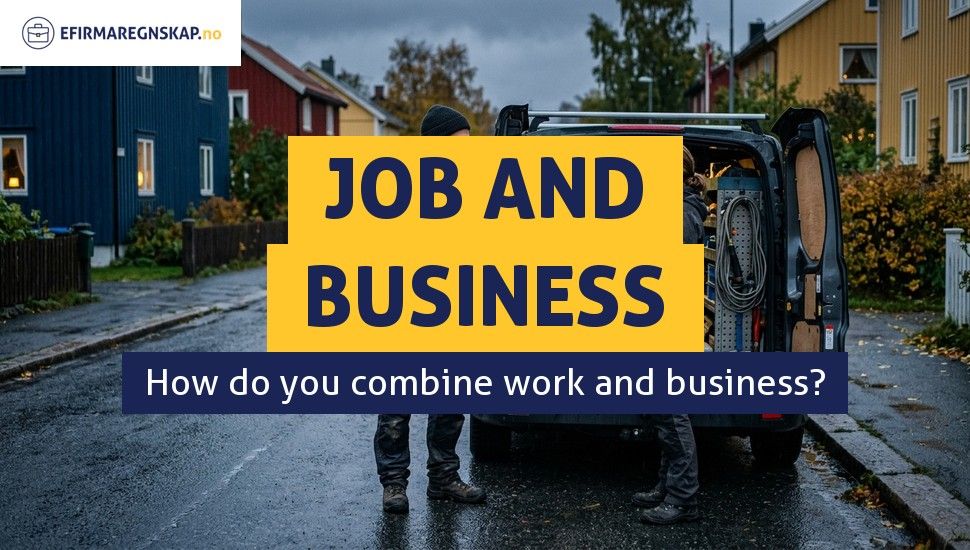
Can I Be Employed and Run My Own Business at the Same Time in Norway?
i work full time in oslo as an electrician. can i do my own jobs after work? do i have to tell my boss?
In this article, we explain how combining employment with your own business works in Norway, what to check in your employment contract, and how to plan taxes, VAT, and basic bookkeeping.
Can you combine employment and your own business in Norway?
Yes, in Norway you can be employed and run your own business at the same time. You can be an arbeidstaker (employee) for one employer and at the same time run an ENK or own and run an AS.
The key is to separate the roles:
- as an employee, you receive lønn (salary),
- in an ENK, you are the business owner and work for yourself,
- in an AS, you can be the owner of the company, a board member, and at the same time an employee of your own company.
However, this combination requires you to keep an eye on three areas: your relationship with your current employer, taxes, and business obligations. Having a job does not remove any of your obligations as a business owner.
ENK or AS when working full time?
In practice, the choice usually comes down to two forms: ENK or AS. Both can be combined with employment, but they work differently from a tax, legal, and organizational perspective.
| Topic | ENK | AS |
|---|---|---|
| Owner status | The owner is self-employed | The company is a separate entity, and the owner is a shareholder |
| Salary for the owner | The ENK owner does not pay themselves a salary | The owner can be employed by their own AS and take a salary |
| Liability | The owner is personally liable for the company's obligations | The owner's liability is generally limited to the capital |
| Starting capital | No minimum share capital | The minimum aksjekapital (share capital) is NOK 30,000 in 2026 |
| Tax | You report ENK profit in your personal tax return | The AS pays tax on profit, and the owner reports salary or dividends |
| Typical use | Simpler side business after hours, lower risk | Higher risk, hiring plans, investors, separating private assets |
Employment + ENK
ENK, or enkeltpersonforetak (sole proprietorship), is closely tied to the owner. The ENK owner cannot be an employee of their own ENK and does not pay themselves a salary. Money transferred from the ENK to a private account is a private withdrawal from the business, and tax is calculated on the business result, meaning income minus costs.
An ENK can employ other people. In that case, the ENK becomes an employer and must handle payroll, tax withholding, and reporting.
Employment + AS
AS, or aksjeselskap (Norwegian limited liability company), is a separate legal entity. The company itself is the taxpayer and is responsible for its obligations. The owner reports privately what they receive from the company as salary or dividends.
If you pay yourself a salary as the owner of an AS, the company becomes your employer. That means payroll obligations: forskuddstrekk (tax withheld from the employee's salary), arbeidsgiveravgift (employer's contribution), and a-melding (monthly payroll and employment report). This a-melding must be submitted every month when the company pays salary.
If you are considering which form to choose, you can find a fuller comparison in the article ENK or AS - which business form should you choose in Norway?
What should you check with your current employer?
In Norway there is no general ban on running a business alongside employment, but as an employee you have a duty of loyalty to your employer. Your side business should not harm your employer's interests, compete with them, or use their clients, secrets, or equipment.
Before registering a business, check:
- your employment contract,
- your employer's internal regulations,
- clauses about bierverv or sidearbeid (additional work),
- confidentiality clauses,
- rules on contact with your employer's clients,
- bans on using your employer's tools, car, materials, or company accounts,
- industry requirements for permits, notifications, or authorization.
Pay special attention to a konkurranseklausul (non-compete clause). After employment ends, such a clause must meet the requirements of arbeidsmiljøloven chapter 14 A, including being in writing and lasting no longer than 1 year after the employment relationship ends.
It is worth talking to your employer before you start taking on jobs in a similar industry. If you work in a completely different field, the risk of conflict is usually lower, but you still need to watch your working hours, rest, and the quality of your employment work.
How do you prepare to combine employment and a business?
The safest approach is to treat it as a short decision process: first the relationship with your employer, then the business form, and only then sales and invoices.
If you are just getting started, you may also find the article You started a business in Norway? Remember this!
FAQ - frequently asked questions
Summary
- You can be employed and run your own business at the same time in Norway, but you must separate your role as an employee from your role as a business owner or AS shareholder.
- With an ENK, you do not pay yourself a salary, but report business profit in your personal tax return. With an AS, you can be employed by your own company.
- Before you start, check your employment contract, duty of loyalty, non-compete rules, taxes, the NOK 50,000 VAT threshold, and basic bookkeeping obligations.
If you need help combining employment and your own business in Norway, call us at +47 21 38 38 21. We help you organize taxes, VAT, and business obligations.
Article author: Marcin - marcin@efirma.no